Cassette tape to digital conversion service
We convert cassette tape to digital for archives, museums, researchers and private collectors. Cassette here means the audio cassette (compact cassette).
Cassette to digital: what affects the result
Every cassette is played on a calibrated studio cassette recorder that is adjusted for that specific cassette. The result is an archival-quality WAV file that captures the full content of the tape. A quick transfer on a consumer player typically loses high frequencies and adds noise.
Cassettes are easy to play, which makes it tempting to assume any player will do. The difference is in the details.
Calibrated studio recorder
A high-quality, calibrated studio cassette recorder reproduces the sound recorded on the cassette accurately across the full frequency range, from low frequencies to high. We calibrate our recorders regularly and verify their frequency response by measurement, so that every frequency is reproduced at the correct level.
Azimuth
The angle of the playback head has to match the angle at which the cassette was recorded. If it does not, high frequencies are lost, and they cannot be recovered afterwards. Home and field recorders were rarely aligned the same way, so the head is adjusted for every cassette. The cassette shell can also warp over time, so side A and side B sometimes need different settings.
Dolby and dbx noise reduction
Many cassettes were recorded with Dolby B, Dolby C or dbx noise reduction. Without a decoder, or with the wrong one, the recording is not reproduced correctly. We identify the encoding and decode it with the matching decoder.
Tape type
Type I (normal) cassettes are played with 120 µs equalization, Type II (chrome) and Type IV (metal) cassettes with 70 µs. The wrong setting either boosts or attenuates high frequencies. The correct setting is the one the cassette was recorded with.
Non-standard speeds and multitrack cassettes
Most cassettes were recorded at the standard 1⅞ ips, but half-speed and double-speed recordings exist, and a standard cassette recorder plays them at the wrong speed. Cassettes recorded on 4-track recorders such as Tascam Portastudios, or on 8-track multitrack cassette machines, do not play correctly on a standard cassette recorder either. These need playback machines that match the original format.
Hear the difference
The same home recording of church organ music, digitized on a correctly adjusted professional cassette recorder:
And digitized with an inexpensive consumer device:
The samples are from our cassette digitization guide.
Cassette tape conversion at Polartape
Every cassette tape transfer starts with an inspection: the tape type, noise reduction and recording speed are identified. The playback head azimuth is then adjusted for each cassette, and separately for each side when needed.
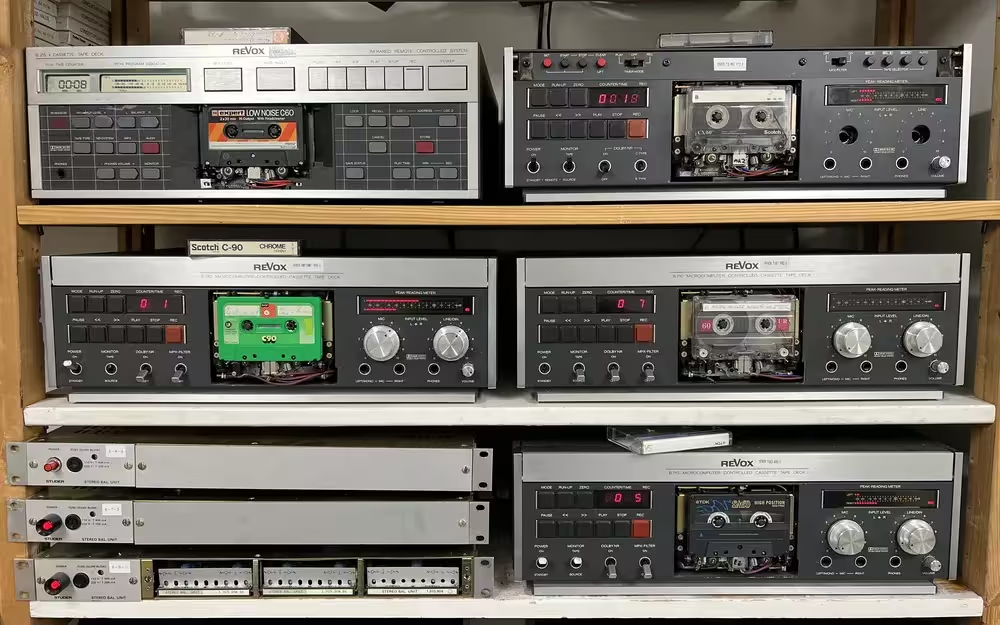
Standard cassettes are played on Studer A710/A721 and Revox B710/B215 cassette recorders. Cassettes recorded at half speed go to a Nakamichi 680ZX and those recorded at double speed to a Tascam 122, so each plays at its original speed. 4-track and 8-track cassettes go to Tascam 424 and 238 machines.
Read more about our quality process or see the full equipment list.
What you receive
By default, you receive 24-bit / 48 kHz WAV files. Higher sample rates and 32-bit float are available on request. Side A and side B are delivered as separate files, in stereo or mono according to the recording. 4-track and 8-track cassettes are delivered as one file containing all tracks. Every delivery includes technical metadata in AudioMD format and MD5 or SHA checksums for each file.
Field recordings preserved for research
The M. A. Castrén Society's collection of linguistic and folklore field recordings was made on compact cassettes with many different recorders. The azimuth varied widely from tape to tape, and adjusting it for each cassette was essential to keep the full audio content. Our cassette clients also include the National Archives of Finland. See more case studies.
Frequently asked questions
Do you transfer VHS or other video cassettes?
Do I need to know the tape type or noise reduction of my cassettes?
Which cassette formats do you digitize?
- Standard compact cassettes (1⅞ ips)
- Half-speed cassettes (15/16 ips)
- Double-speed cassettes (3¾ ips)
- 4-track cassettes (1⅞ and 3¾ ips)
- 8-track multitrack cassettes (3¾ ips)
Do you decode Dolby B and Dolby C?
Are both sides of the cassette transferred?
Can you handle broken or moldy cassettes?
Can I send cassettes from outside Finland?
Do I get my original cassettes back?
Can you handle a large collection?
Tell us about your cassettes
Let us know how many cassettes you have. We will reply with a plan and a cost estimate. Our tape to digital service also covers reel-to-reel tapes and other audio formats.